Introduction to Astrology & Your Natal Chart
Understanding the basics of astrology and compatibility.
What is Astrology?
Astrology is an ancient practice that studies the positions and movements of celestial bodies (like planets and stars) and explores their potential correlation with events and personality traits here on Earth. Think of it less like fortune-telling and more like a complex language or system for understanding potential energies, archetypes, and life patterns.
For thousands of years, cultures around the world have looked to the skies, observing cycles and drawing connections. Modern Western astrology, which the Astro-Grid uses, focuses heavily on the natal chart (or birth chart) as a tool for self-discovery and understanding relationships.
It's a symbolic map, offering insights into your potential strengths, challenges, motivations, and how you might interact with the world – and with other people.
What is a Natal Chart?
Your natal chart is a map of the sky with the earth in the center. Everything on the top half of the chart was visible in the sky at the moment you were born. Everything on the bottom half of the chart was below ground. As the Earth rotates this map changes, and that is why the exact time of birth is required. The sky also looks different depending on how far north or south of the equator you were born. This changes how large or small the constellations appear to be from that location and affects the size of the “houses” in your chart. When you look up and see a planet in the sky, there will be one of the 12 Signs of the Zodiac visible behind that planet. This is why we say someone’s Sun or Jupiter is in Aries or Aquarius. Your “Sun Sign” refers to which constellation of stars (Sign) was behind the Sun when you were born. The constellation which was rising above the eastern horizon at the moment you were born is your Ascendant or Rising Sign.
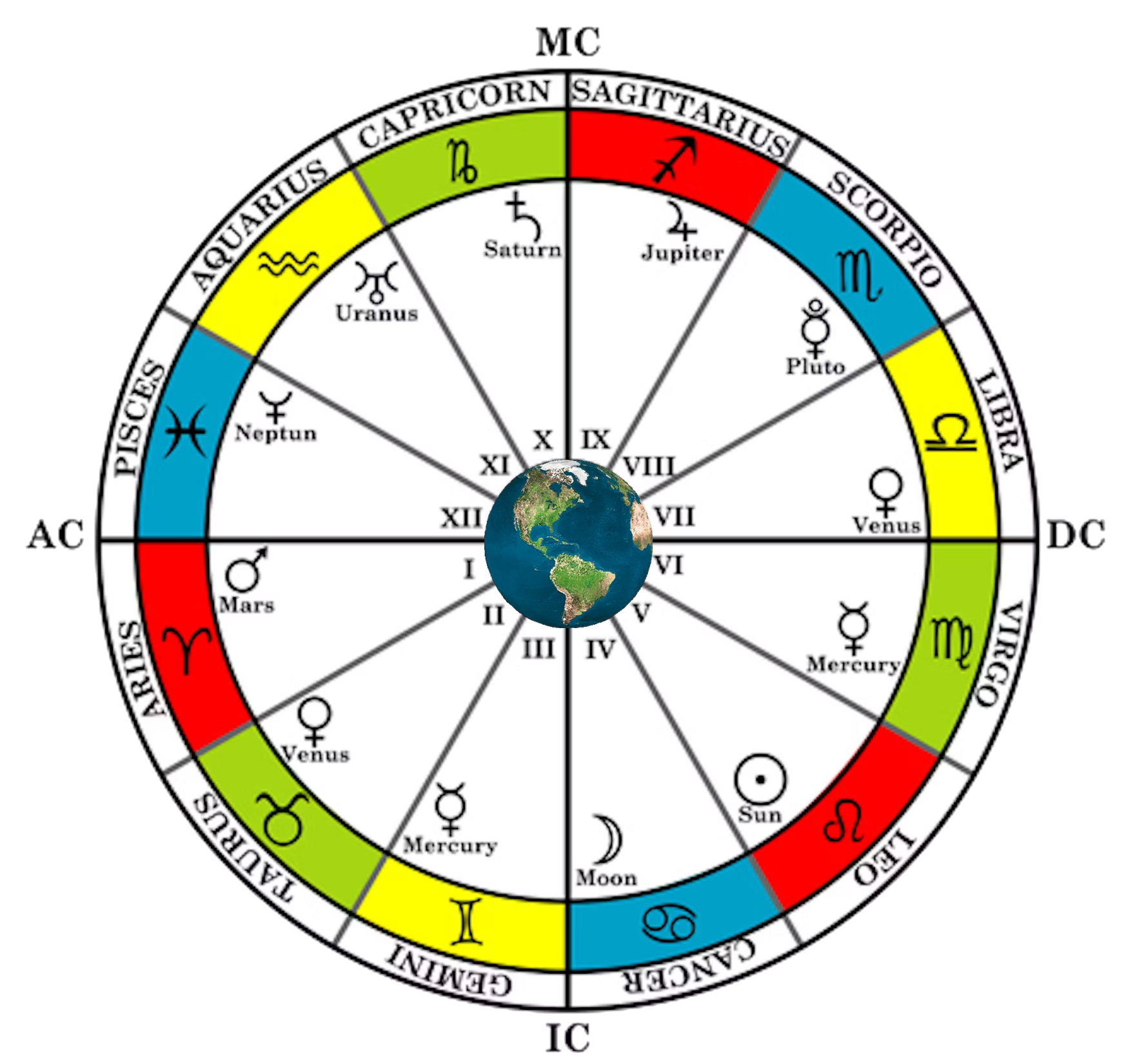
The illustration above shows the relationships between the Signs (ie, Aries, Taurus, etc.) and their “ruling” planets (Mars, Jupiter, etc.). For example, Aries is ruled by Mars, and Taurus is ruled by Venus. “Ruled” simply means “associated with.” For example, Aries and Mars have similar interpretations in astrology, as do Taurus and Venus, etc. The colors represent the “element” associated with a Sign. Aries is a “Fire Sign” (red) and Taurus is an “Earth Sign” (green). Yellow indicates an Air Sign and blue indicates a Water Sign. The natal chart is divided into 12 sections called houses. The first house (1) indicates your Ascendant (AC). The three most significant parts of a natal chart are the Sun Sign (who you are inside), the Moon (how you process emotions) and the Ascendant or Rising Sign (how you present yourself to the world).
In astrology, each Sign has a number of qualities or meanings associated with it, as do each planet and each house. The angles between the planets (aspects) also indicate specific qualities or meanings. All of these individual qualities in your natal chart (the map of the sky when you were born) are combined to produce interpretations describing your personality. Comparing where the planets are now (transiting) in relation to where they were when you were born (natal) is how astrologers describe the current influences occurring in one’s life. Comparing your natal chart to the natal chart of someone else (synastry) is how astrological compatibility is described.
Key Components (We'll cover these in more detail later!):
- Planets: Represent different facets of your personality and life functions (e.g., the Sun represents your core identity, the Moon your emotions, Venus your love language, Mars your drive).
- Zodiac Signs: The 12 signs (Aries through Pisces) represent how the planets express their energy. If your Sun is in Leo, your core identity tends to express itself in a Leonine way (confident, creative, dramatic).
- Houses: The chart is divided into 12 segments called houses, each representing a different area of life (e.g., 1st house is self/identity, 7th house is partnerships, 10th house is career). Which house a planet falls in shows where in your life its energy tends to manifest.
- Aspects: These are significant geometric angles between planets in the chart. They describe how different parts of your personality interact. Trines (120 degree angle) and Sextiles (60 degree angle) are generally harmonious. Squares (90 degrees) and Oppositions (180 degrees) can be dynamic and challenging.
The Astro-Grid uses detailed natal-chart information as the foundation for synastry – the comparison of two charts to explore relationship compatibility. By examining the aspects between one person's planets and another person's planets, along with other chart relationships, the Astro-Grid can generate detailed insights into how their astrological patterns interact.